A New Logo for the WNBA? Sophie Cunningham’s Bold Proposal Sparks Debate
In professional sports, a logo is never just an image. It represents history, identity, and the values a league wants to project to the world. For decades, the Women’s National Basketball Association (WNBA) has used a sleek, elegant logo symbolizing grace, movement, and athletic excellence. But Phoenix Mercury guard Sophie Cunningham has recently stirred major conversation by suggesting it might be time for a radical change—one that flips the script on how women’s basketball is perceived.
Her idea? Replace the current logo with a player sporting a chipped tooth.
The concept might sound unconventional at first glance, but Cunningham’s reasoning digs deep into the spirit of the game.
“I think we should change the logo to a chick with a chipped tooth,” Cunningham said.
The comment wasn’t just a throwaway joke. It was rooted in her own on-court experience. Cunningham has endured the physical toll of elite-level basketball, including suffering a chipped tooth during play. For her, that moment wasn’t about weakness or embarrassment—it became a symbol of toughness, resilience, and authenticity.

Why a Chipped Tooth Matters
In mainstream culture, chipped teeth are often associated with imperfection. But Cunningham’s proposal flips that narrative. To her, the chipped tooth embodies the raw, physical reality of women’s basketball:
-
Grit: Games are not just about elegance; they’re about diving for loose balls, battling under the rim, and sacrificing the body.
-
Authenticity: Too often, women athletes are expected to conform to ideals of perfection and beauty. A chipped tooth challenges that stereotype and embraces the reality of competition.
-
Resilience: Injuries and setbacks happen, but they don’t stop athletes from pushing forward.
By suggesting this logo, Cunningham is essentially asking: Why not show the world the toughness behind the game, instead of just the polished surface?
A Cultural Shift in Branding
Sports branding is evolving. In the NBA, NFL, and even global soccer, there’s been a move toward authenticity—highlighting not only the glory but also the grind. For the WNBA, a chipped-tooth logo would represent a bold cultural statement: that women’s basketball isn’t about being pristine or delicate, but about strength, courage, and fearlessness.
This idea fits into a larger conversation about how women athletes are portrayed in media. For decades, the emphasis has often been on aesthetics rather than athleticism. Cunningham’s suggestion is a direct challenge to that: a call to focus on the toughness and sacrifice it takes to play the game at the highest level.
Fans React: Support, Criticism, and Curiosity
Since Cunningham’s comments surfaced, fans have been divided—but undeniably engaged. On social media, some praised her for her boldness, saying the chipped-tooth logo would be a refreshing dose of realism. Others criticized the idea, arguing that logos should inspire, not shock.
One fan on Twitter wrote: “I love it. It shows who these women really are—warriors on the court.”
Another countered: “Cool idea, but would a chipped tooth really attract new fans? The logo should inspire kids, not scare them.”
Regardless of where people stand, the conversation itself highlights an important truth: Sophie Cunningham succeeded in sparking dialogue about how women’s sports are branded.
The Symbolism of Imperfection
There’s something powerful about embracing imperfection. A chipped tooth isn’t traditionally considered “beautiful,” but in the context of sports, it tells a story of sacrifice, persistence, and toughness. Just as scars can symbolize battles fought, a chipped tooth becomes a mark of resilience.
Cunningham’s idea echoes a growing movement across sports and culture—where authenticity is celebrated over polish, and imperfection is worn with pride.
What This Could Mean for the WNBA
While it’s unlikely the WNBA will actually adopt a chipped-tooth logo anytime soon, the idea has already done its job. It’s forced a conversation about:
-
Representation: What do we want women’s basketball to look like to the world?
-
Identity: Should the league highlight elegance, or should it highlight toughness—or both?
-
Marketing Strategy: How can the WNBA differentiate itself from other sports leagues and appeal to new generations of fans?
Even if the league never makes the change, Sophie Cunningham’s bold suggestion may inspire new ways of thinking about branding, authenticity, and identity in women’s sports.

Cunningham’s idea presents a direct challenge to the WNBA’s polished image. The current logo, a silhouette of a player in motion, is clean, dynamic, and aesthetically pleasing. It aligns with a traditional approach to marketing women’s sports, which often emphasizes elegance and finesse. Cunningham argues that this portrayal, while not inaccurate, is incomplete. She feels that the league is more than just “pretty” and that its primary symbol should reflect the battles waged on the hardwood every night.
This suggestion has sparked a broader debate about authenticity in sports branding. Should a league’s logo represent an idealized version of its athletes, or should it reflect the raw reality of the competition? By advocating for an imperfect, more rugged symbol, Cunningham is making a case for the latter. She points to her teammates and competitors as examples of fierce athletes who are unafraid of the physical demands of the game. A logo that acknowledges this reality could, in her view, resonate more deeply with players and fans alike.
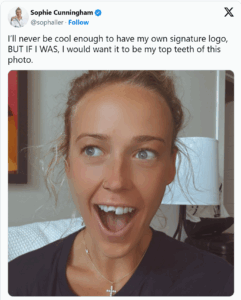
Rethinking the WNBA’s Identity Through Sophie Cunningham’s Lens
The debate sparked by Sophie Cunningham goes far beyond the question of a logo redesign. It’s not just about a single image — it’s about the entire story the WNBA tells the world. As the league gains momentum, breaking viewership records and capturing global attention, its brand identity has never been more critical. Cunningham’s proposal forces athletes, fans, and league officials to confront an important question: What should the WNBA represent?
Is it a league that prioritizes elegance and grace, showcasing the artistry of basketball?
Is it a league that highlights toughness, grit, and resilience, where every scar tells a story?
Or perhaps it’s a league that embraces both sides of the game—the beauty and the battle.
What makes Cunningham’s idea so compelling is that it dares to celebrate imperfection. A chipped tooth, something often hidden or fixed, becomes a badge of honor—an emblem of sacrifice, strength, and the warrior spirit of women’s basketball.
Even if the WNBA never officially adopts this bold concept, Cunningham has already succeeded. She has shifted the conversation to something bigger: how the league chooses to define itself in the eyes of the world. Her proposal invites us to view athletes not just as polished professionals, but as fierce competitors who embody both resilience and grace.
At the heart of this discussion lies a powerful truth: the identity of the WNBA is still being written. Sophie Cunningham’s bold vision reminds us that the league’s greatest strength may not be choosing between toughness and elegance—but embracing both as inseparable parts of its story.


