A League Under Siege: The Vicious Backlash and Uncomfortable Questions Facing the WNBA
For the better part of three decades, the WNBA operated in a quiet corner of the sports universe. It existed, it had a small but loyal fanbase, but it rarely broke through into the national conversation. That all changed with the arrival of one player: Caitlin Clark. Her record-breaking college career brought with it a tidal wave of hype and media attention that the league had never experienced. This was supposed to be its moment of triumph. Instead, it has become a moment of reckoning. The newfound spotlight has illuminated not just Clark’s talent, but also a furious, widespread, and often vicious public backlash that questions the league’s finances, its quality of play, and its very right to demand respect.
The most explosive front in this new culture war is the debate over money. For years, the league and its players have campaigned for pay equity with their NBA counterparts, framing the disparity as a straightforward issue of gender discrimination. That narrative is now being aggressively challenged by a growing chorus of critics, comedians, and commentators who are armed with hard numbers and a complete lack of sentimentality. Their argument is simple: it’s not about gender, it’s about revenue.

Comedians like Bill Burr have, perhaps unintentionally, become the blunt, unfiltered mouthpieces for a perspective that many hold privately but few dare to say out loud. Burr, in a now-iconic stand-up routine, distilled the economic skepticism surrounding the WNBA into a single line that continues to reverberate: “We gave you a league.” Delivered with his trademark mix of sarcasm and fury, the bit crystallized a growing sentiment — that the WNBA is not, in its current state, a self-sufficient enterprise, but rather an institution sustained largely by the financial backing and infrastructure of the NBA.
From there, Burr doubled down, asking the piercing follow-up question: Where are the legions of feminists and vocal supporters when it comes to actually buying tickets? His point, crude as it was, tapped into a longstanding criticism — that the volume of advocacy for women’s sports often outweighs the tangible consumer support in arenas, television ratings, and merchandise sales.
This critique has not remained confined to the comedy stage. It has been amplified and dissected across countless podcasts, talk shows, and social media feeds where analysts lay out the hard math. The WNBA season is shorter than the NBA’s. The games themselves are shorter. Viewership, while growing in recent years, is still only a fraction of the NBA’s massive global audience. And according to reports, the league continues to lose millions annually, relying on the NBA’s subsidy and shared resources to stay afloat. The uncomfortable evolution of the debate has shifted the framing of the question. It’s no longer just, “Why aren’t WNBA players paid more?” Instead, critics are now asking, “Why are they being paid at all if the league itself cannot generate sustainable revenue?”
Layered onto the economic skepticism is an even sharper critique of the on-court product itself. Detractors argue that the WNBA simply cannot compete with the spectacle of men’s basketball. They highlight the lack of above-the-rim play — particularly dunking, which has become a visual and cultural staple of the NBA. They describe the pace of the women’s game as slower, the offensive strategies as less dynamic, and the overall skill level as comparatively lower. Some comedians have taken this critique to absurd extremes: one mocked a typical WNBA matchup as nothing more than endless passing “because players are afraid to shoot,” while another scoffed that a final score might look like “21 to 2.”
Supporters of the WNBA, of course, push back strongly, insisting that these critiques are not only unfair but rooted in bias and lazy stereotypes. They argue that the women’s game should be appreciated on its own merits, with its own style of play, strategy, and athletic brilliance. But critics counter with a hard truth about the entertainment industry: fairness doesn’t drive consumer behavior. Attention does. If the product fails to captivate a mass audience, they argue, it cannot reasonably demand mass-market salaries or mainstream cultural dominance.
And so the debate rages on — between those who see the WNBA as undervalued and disrespected, and those who view it as a subsidized venture with limited appeal, propped up more by principle than by profit.
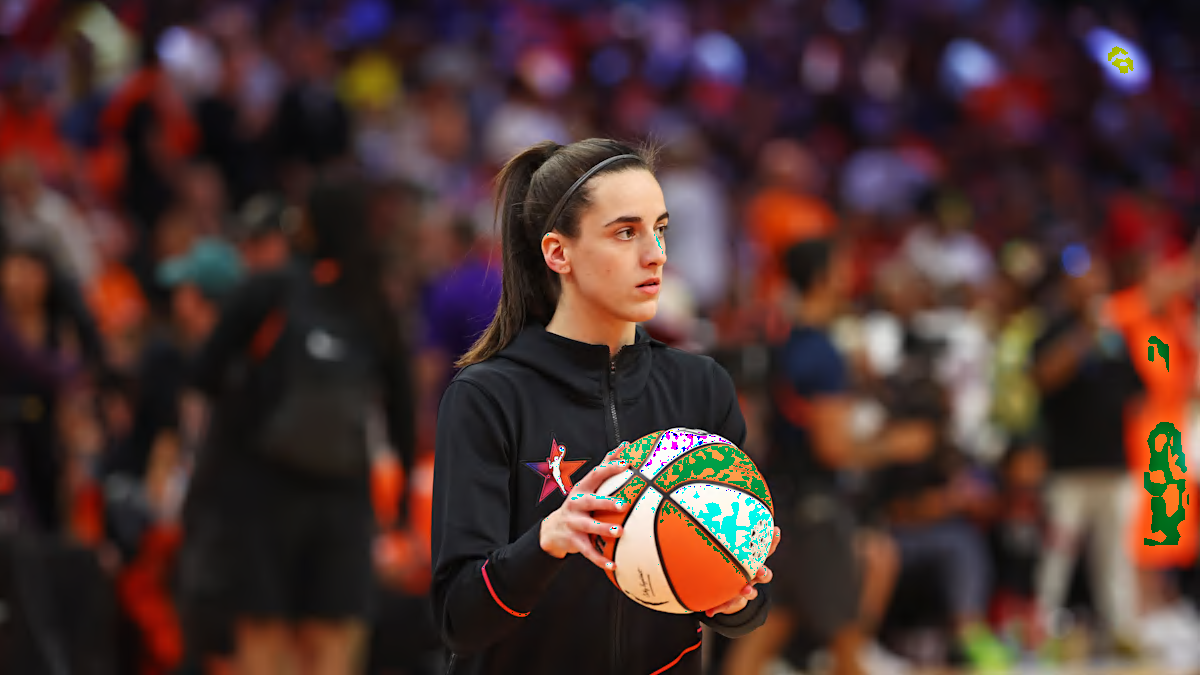
The arrival of Caitlin Clark has ironically made things worse. While she has undeniably been a commercial boon—selling out arenas and shattering viewership records—her presence has exposed a deep-seated tension within the league itself. From her very first game, Clark has been subjected to a level of physical aggression from veteran players that many observers find alarming. She has been hip-checked, shouldered, and knocked to the floor with a regularity that goes beyond typical rookie hazing.
This on-court hostility has fueled a powerful narrative that the league’s established players are jealous of Clark’s stardom and are actively trying to diminish her. Instead of embracing the transcendent star who is single-handedly boosting their salaries and profiles, they appear to resent her. One commentator vividly described watching her play as being “like watching The Longest Yard,” a brutal spectacle of people trying to beat her up. This internal conflict has provided ample ammunition for critics, who now portray the league as not only financially unviable but also self-sabotaging.
The discourse has taken bizarre and ugly turns. The rivalry between Clark and Angel Reese has been accompanied by cruel, personal jokes about Reese’s appearance. And in one of the strangest developments, fans have repeatedly disrupted games by throwing sex toys onto the court. This act of profound disrespect has become a running joke and a humiliating symbol of the league’s struggle to be taken seriously.
The WNBA is now trapped in a perfect storm. It has the superstar it has always dreamed of, but her fame has brought with it a level of scrutiny it was wholly unprepared for. Every hard foul, every unfiltered comment from a comedian, and every empty seat in a non-Clark game is now magnified and debated online. The league is fighting for respect on all fronts—from the public, from the media, and seemingly, from within its own locker rooms. The uncomfortable truth is that for the WNBA, the game on the court has become secondary to the vicious battle for its own survival.


